

Sustainable Fashion Needs To Be More Like Fast Fashion
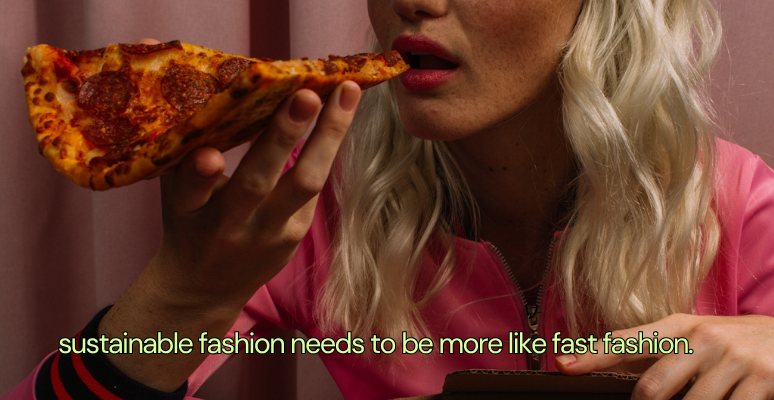
Sustainable fashion needs to be more like fast fashion. Not in the way it exploits, or overproduces, or devalues, but in the way it understands what people think they need.
Into unpopular opinions? Sustainable fashion needs to be more like fast fashion.
I started my career inside fast fashion, where trends were manufactured overnight (or however long it took for a Kardashian to post a new look). Product presentation and storytelling were weaponised to make people want.
I was part of an industry that perfected the art of attention: rapid cycles, emotionally charged marketing, and a hyper-responsive system that could turn a scroll into a sale in seconds.
I’m not saying any of that is good - I left for a reason. But it taught me something invaluable - fast fashion is a hell of a lot more than a production model. It’s a psychological engine.
It knows how to make people feel something - and that’s exactly what sustainable fashion has failed to.
Sustainable Fashion Has a Communication Problem
A huge one.
When I pivoted my career from fast fashion, I spent years studying and working in how sustainability is communicated, how people interpret it, and how creative strategy might reconnect fashion to meaning.
Through client work, independent research, and hundreds of conversations, one pattern has always stood out: most people believe sustainability is important, but very few feel genuinely emotionally connected to it.
The visuals and language of sustainable fashion are too often coded in beige palettes, moralising captions, and technical jargon. The tone is instructional when it should be inspirational. It alienates more than it invites.
Fast Fashion and the Dopamine Economy
Much like fast food, fast fashion delivers a dopamine hit.
It’s engineered for the instant gratification loop our brains crave - the thrill of new, the pleasure of discovery, the subtle social validation of being in on the latest thing.
Dopamine is an anticipation chemical as much as it is a reward chemical. It spikes before we buy, not after. Fast fashion psychology plays the game of constant micro-rewards: new drops, flash sales, influencer hauls, the ‘back in stock’ ping that feels like a love language.
Every element is designed to create the feeling of novelty and belonging. Not just owning clothes - they’re unfortunately pretty irrelevant in this paradigm - it’s being part of something moving, alive, culturally fluent that is the best-selling product.
Sustainable fashion, meanwhile, tends to market the opposite of that. It sells responsibility. It speaks to conscience, not chemistry. Ethical narratives framed through guilt or fear might inform, but they rarely transform. They can make people withdraw, not act.
People buy from emotion, not guilt. They buy from what connects to their identity, their aspirations, their sense of self.
A Game of Desire
If sustainable fashion wants to grow, it can’t just demand ethical obligation - it has to compete on desire.
The next evolution of sustainability is about re-engineering the same attention systems that fast fashion dominates, but directing them toward better outcomes: longevity, creativity, and meaning.
We can reframe the dopamine loop by reshaping it. The human need for novelty, self-expression, and belonging isn’t going anywhere, but how we satisfy it can evolve.
Sustainability Needs a New Strategy
If sustainable fashion wants to invite more people to join the movement, it can’t just demand ethical obligation. It must learn what fast fashion mastered - how to make people want the change.
From translating value, reframing aesthetics, communicating price to driving newness, Irigai will be exploring how sustainable fashion can learn from the systems it’s trying to replace. The goal isn’t to mimic fast fashion’s flaws. It’s to master its mechanics, then use them better.
At Irigai, we translate values into creative strategies that drive emotion, attention, and action.
Learn more.

Small Steps Create Big Shifts
It All Begins Here
Confidence doesn’t always arrive with a bold entrance. Sometimes, it builds quietly, step by step, as we show up for ourselves day after day. It grows when we choose to try, even when we’re unsure of the outcome. Every time you take action despite self-doubt, you reinforce the belief that you’re capable. Confidence isn’t about having all the answers — it’s about trusting that you can figure it out along the way.
The key to making things happen isn’t waiting for the perfect moment; it’s starting with what you have, where you are. Big goals can feel overwhelming when viewed all at once, but momentum builds through small, consistent action. Whether you’re working toward a personal milestone or a professional dream, progress comes from showing up — not perfectly, but persistently. Action creates clarity, and over time, those steps forward add up to something real.
You don’t need to be fearless to reach your goals, you just need to be willing. Willing to try, willing to learn, and willing to believe that you’re capable of more than you know. The road may not always be smooth, but growth rarely is. What matters most is that you keep going, keep learning, and keep believing in the version of yourself you’re becoming.

Turn Intention Into Action
It All Begins Here
Confidence doesn’t always arrive with a bold entrance. Sometimes, it builds quietly, step by step, as we show up for ourselves day after day. It grows when we choose to try, even when we’re unsure of the outcome. Every time you take action despite self-doubt, you reinforce the belief that you’re capable. Confidence isn’t about having all the answers — it’s about trusting that you can figure it out along the way.
The key to making things happen isn’t waiting for the perfect moment; it’s starting with what you have, where you are. Big goals can feel overwhelming when viewed all at once, but momentum builds through small, consistent action. Whether you’re working toward a personal milestone or a professional dream, progress comes from showing up — not perfectly, but persistently. Action creates clarity, and over time, those steps forward add up to something real.
You don’t need to be fearless to reach your goals, you just need to be willing. Willing to try, willing to learn, and willing to believe that you’re capable of more than you know. The road may not always be smooth, but growth rarely is. What matters most is that you keep going, keep learning, and keep believing in the version of yourself you’re becoming.

Make Room for Growth
It All Begins Here
Confidence doesn’t always arrive with a bold entrance. Sometimes, it builds quietly, step by step, as we show up for ourselves day after day. It grows when we choose to try, even when we’re unsure of the outcome. Every time you take action despite self-doubt, you reinforce the belief that you’re capable. Confidence isn’t about having all the answers — it’s about trusting that you can figure it out along the way.
The key to making things happen isn’t waiting for the perfect moment; it’s starting with what you have, where you are. Big goals can feel overwhelming when viewed all at once, but momentum builds through small, consistent action. Whether you’re working toward a personal milestone or a professional dream, progress comes from showing up — not perfectly, but persistently. Action creates clarity, and over time, those steps forward add up to something real.
You don’t need to be fearless to reach your goals, you just need to be willing. Willing to try, willing to learn, and willing to believe that you’re capable of more than you know. The road may not always be smooth, but growth rarely is. What matters most is that you keep going, keep learning, and keep believing in the version of yourself you’re becoming.