

Manchester Fashion Week: the big questions.
We’ve become pretty accustomed to fashion weeks telling us what comes next, at least in theory. Colours, shapes, the occasional hideous ragebait shoe.
But in its second year, Manchester Fashion Week was asking questions. felt like it was trying to answer a different question entirely.
What kind of industry are we actually building?
Our founder Beth attended the event. Walking between panels, exhibitions and conversations, kept noticing something unusual. The runway wasn't competing with discussions on repair. Material innovation wasn't sitting in a sustainability corner. Universities, manufacturers, investors, campaigners and designers weren't operating in separate rooms.
Being at the event was watching fashion behave like the ecosystem it should be. It was diverse, it was collaborative, it was honest.
The panels at the event were next level. Here, we breakdown what they covered.
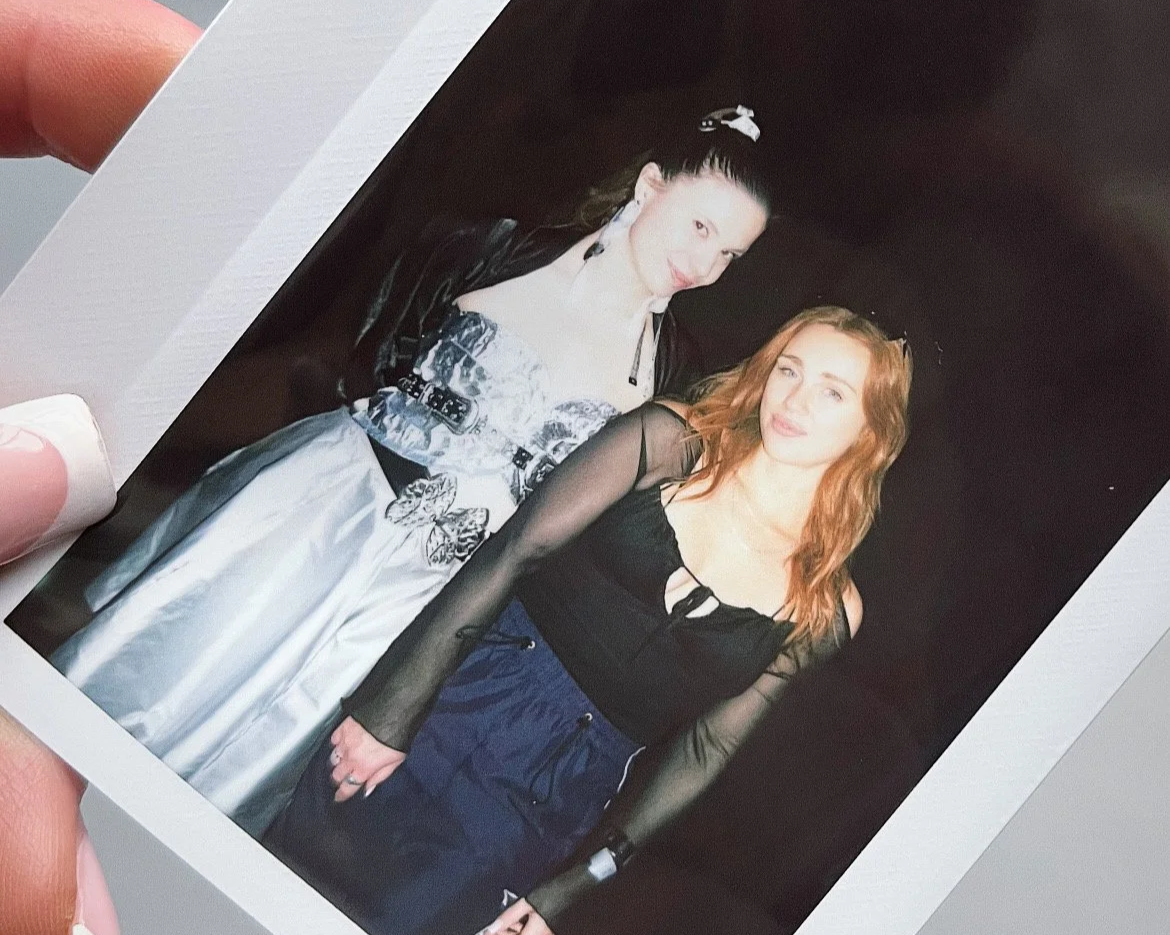
Kristina Bozhinova + Beth Arthurs before the Susty Runway
A standard designers cannot opt out of
Arguably, the clearest signal came before the first show. Developed alongside Collective Fashion Justice, Manchester's framework prohibits fur, wild animal skins and wild bird feathers entirely, while allowing leather only where it is already in circulation.
Fashion weeks have historically rewarded creativity while leaving responsibility largely to individual brands. Manchester is experimenting with something different: making better practice part of the platform itself.
The runway becomes conditional, and access carries expectations.
We've already seen Copenhagen Fashion Week move in this direction. London has strengthened its sustainability requirements too, New York is the latest fashion week to ban fur. Manchester is adding another important voice to a growing conversation under what conditions visibility.
The North already has everything a fashion system needs
One theme surfaced across almost every conversation.
The North has designers, it has manufacturers, it has universities, it has centuries of textile history. What it has often lacked is the connective tissue between them. Along with finding visibility in London’s shadow.
The timing feels significant. As city mayor Bev Craig opened the event, Manchester is already in the middle of wider political conversations around regional investment and Andy Burnham's push to decentralise economic power away from the capital.
Founders and leaders of the the Northern Fashion Collective - Gemma Gratton, Hayley Shaw, Liz Scott, Charlene Gallery and Paul Foulkes-Arellano anchored a key idea that teed up the whole event - stop building isolated initiatives and start building shared infrastructure.
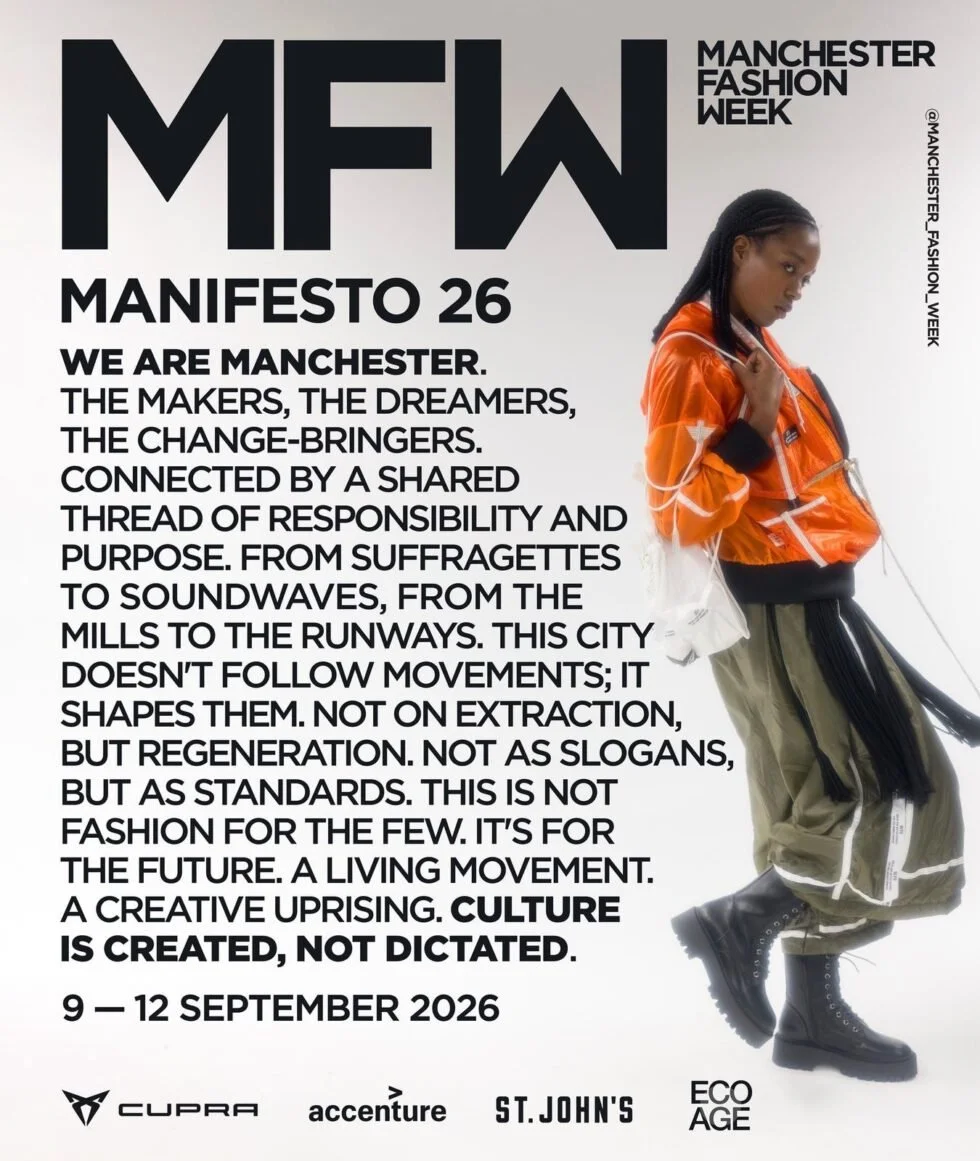
We have forgotten how clothes are, and can be made
Across exhibitions, including Castlefield Gallery's Interwoven and the accompanying materials library, there was a recurring frustration that consumers - and increasingly parts of the industry itself - have lost sight of what happens between an idea and a finished garment.
Making, repairing, spinning, weaving. These weren’t nostalgic conversations, but practical. Because once those skills disappear, so does our ability to imagine different production systems.
A really interesting discussion on this topic came from Laurie Peake, Kirsteen McGregor and Vanessa Barker exploring regenerative fibre systems. We can grow hemp, we can grow linen. The problem is lack of trust and investment in our capability. Harvesting, spinning and weaving.
Those skills have largely disappeared from the UK, and rebuilding them depends as much on investment, education and long-term industrial confidence as it does on planting the physical seeds.
The material conversation is becoming more honest, and the materials panels were refreshingly unwilling to pretend there are easy answers. One moment we'd be discussing hemp and regenerative systems, and the next we'd be talking about polyester's uncomfortable reality - a big shout out to Samantha Taylor for her receipts-laden presentation on the complexities of plastic.
But these conversations definitely weren’t trying to ask ‘what's the perfect material?’, but instead ‘how do we make better decisions within imperfect systems?’ So much more productive.
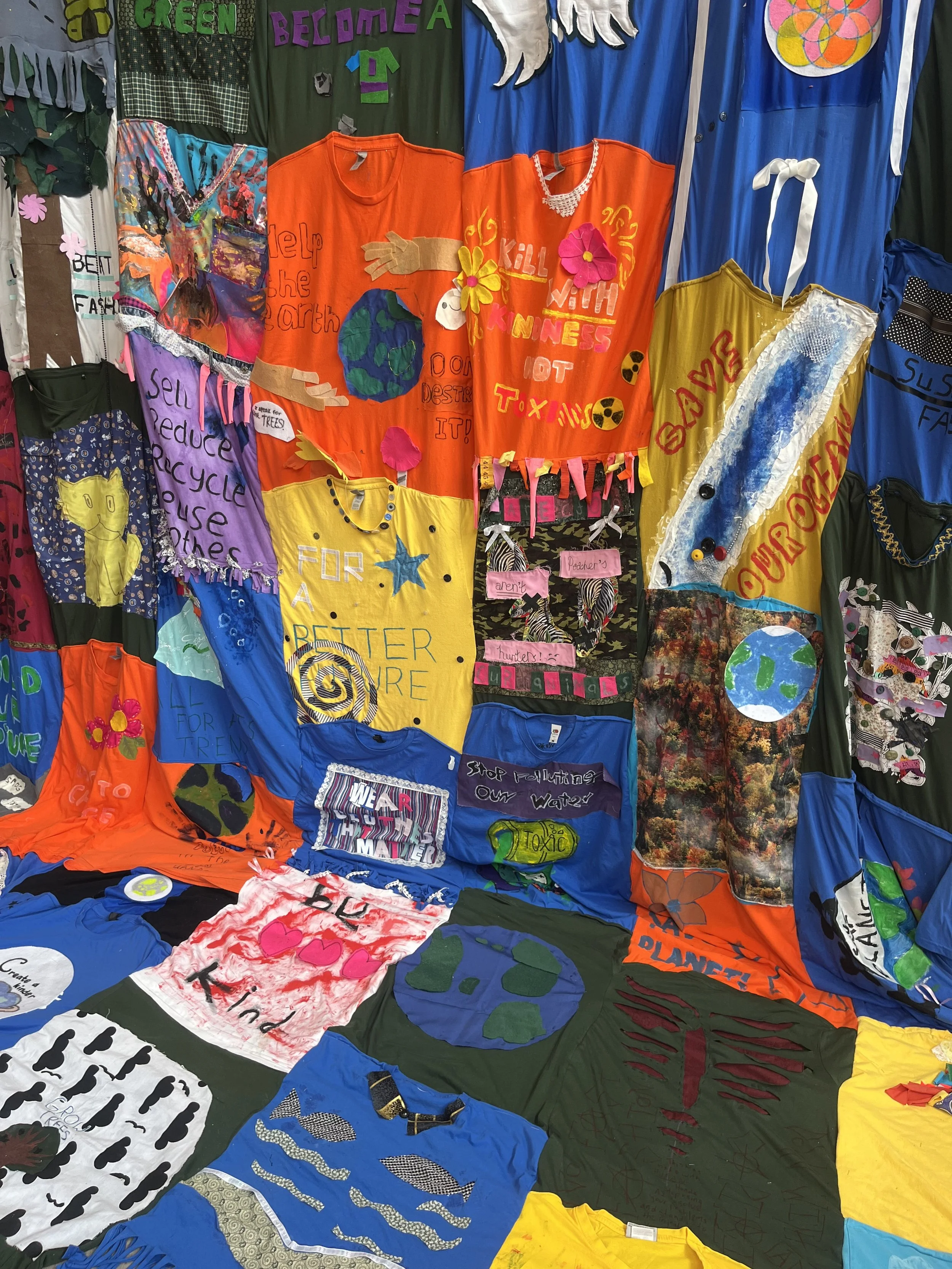
Northern Fashion Collective’s T-Shirt installation at Castlefield Gallery's Interwoven
Ethics shouldn't stop at humans
One of the week's most thought-provoking conversations came through Collective Fashion Justice around what Emma Hakansson describes as ‘total ethics fashion’.
Animal welfare often sits strangely outside mainstream sustainability conversations. The discussion challenged that separation entirely.
Rather than presenting the choice as animal leather versus plastic alternatives, the focus shifted towards ethics-derived materials that are simultaneously animal-free, plastic-free and less toxic.
A very exciting example of this is action on the panel was TJ Edward Mitchell, Co-founder of Arda Biomaterials, using spent brewery grain and plant proteins to mimic collagen structures while working backwards from commercial price targets rather than purely scientific ambition.
Commercial thinking matters to scale sustainable systems. Paul Foulkes-Arellano noted in the discussion that ‘New materials need to become cheaper and sexier’ to have land with any kind of viability. It’s not cynical, but it’s realistic. Reframing price in this conversation is really important to scaling the growth, and it turn affordability, of the biomaterials space.
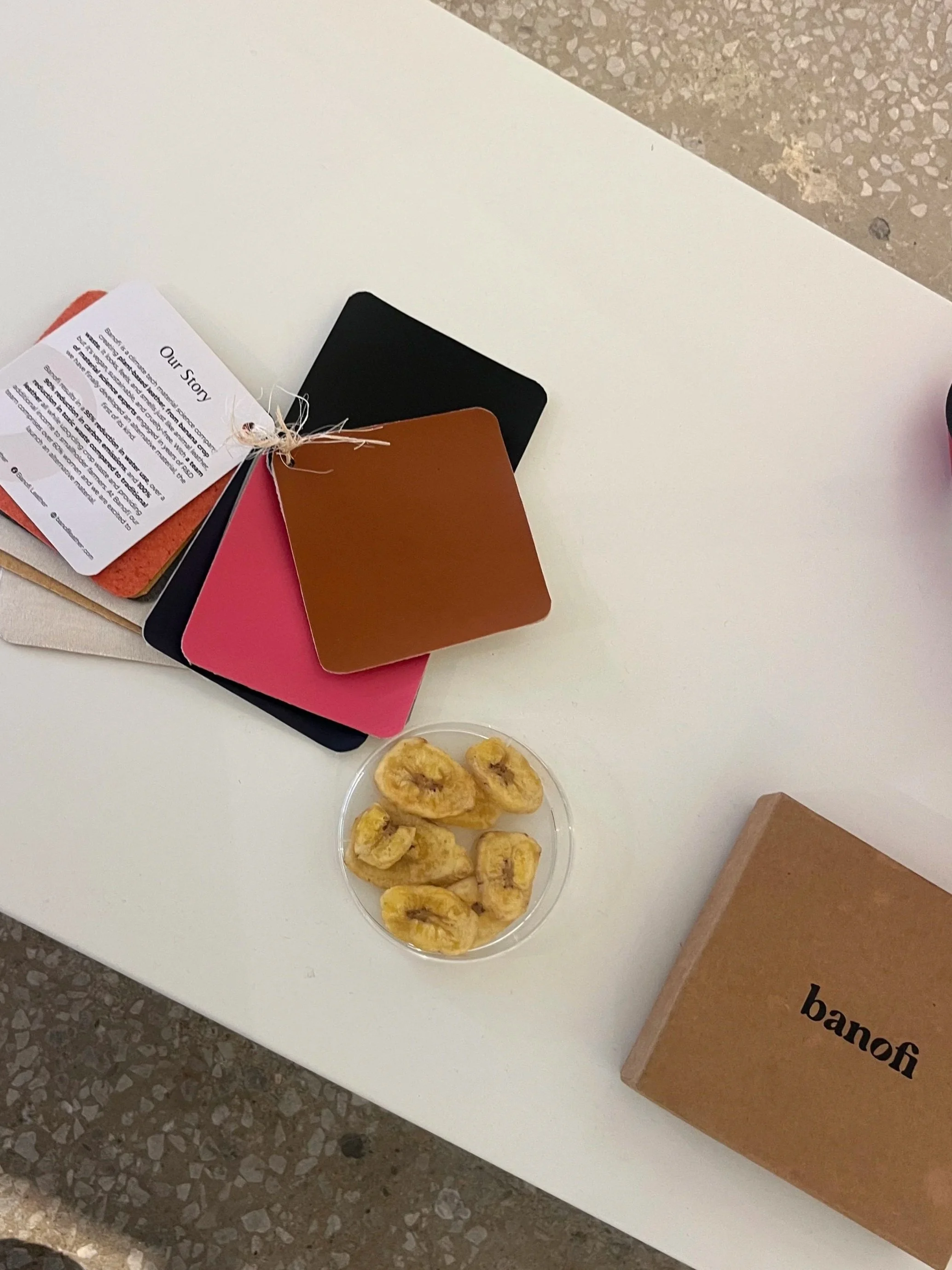
Biomaterials at the Castlefield Gallery's Interwoven’s materials library - Banofi pictured here.
Speaking of commerciality - let’s talk circularity
One of the strongest commercial conversations came from Reskinned co-founder Matt Hanrahan alongside Nobody's Child Head of Sustainability Philippa (Philly) Grogan during the Circular High Street panel.
The commercial abundance that circularity offers shifts sustainability conversations in the boardroom away from ‘save the dolphins’ and into business strategy that gets taken seriously (to paraphrase Philly).
Resale increases share of wardrobe, returns create design feedback loops, Digital Product Passports begin tracking products across multiple lives.
Matt spoke about reaching a point where products moving through Reskinned's system can eventually inform fibre-to-fibre decisions - that is an extraordinary shift, and demonstrates to anybody who is wary of being a first mover on new, scary, circular systems that the commercialisation of non-linear fashion systems is no longer theoretical - it's absolutely operational.
The repair panel with Hayley McDonald from ACS and Gareth Cullen from Nudie Jeans framed something we at Irigai anchor as a key industry issue - repair has a branding problem. People often avoid repair because repaired clothes don't look new, which makes repair partly a communication challenge. Repair has to become culturally desirable, and affordable, if it's going to scale with any tangibility.
Nudie has spent years making visible repairs part of its brand language, while building repair costs directly into its commercial model rather than treating them as an afterthought.
Who is fashion for?
There were some frank and v necessary conversations held on panels.
The adaptive fashion conversation led by Victoria Jenkins from Unhidden, alongside Ellie Brown, Emma Fazackerley and Hanan Tantush, outlined how that despite around one in four people in the UK live with a disability, fashion still largely designs around one narrow idea of a body.
Victoria's work challenged that assumption in the unhidden runway, the panel pushed it further. Accessibility isn't a niche category - in fact, the panel raised that the global disability market holds an estimated $18 trillion in annual spending power.
This really aligned with the conversations from the FACE – Fashion and the Arts Creating Equity panel with Charlene Gallery of University of Manchester, FACE Vice-chair Benita Atkinson and Tanveer Ahmed, lecturer at Central Saint Martins.
It started with what feels like a deceptively simple question - ‘Who gets access to fashion?’
Because who belongs, and who gets made visible, rarely begins with a graduate job or a fashion week invitation. It starts much earlier, in classrooms, in confidence, in whether someone walks into an institution believing it was built with them in mind.
Benita described how that thinking has shaped FACE's work ever since - not simply asking how we diversify fashion, but how we make people feel welcome enough to stay in it.
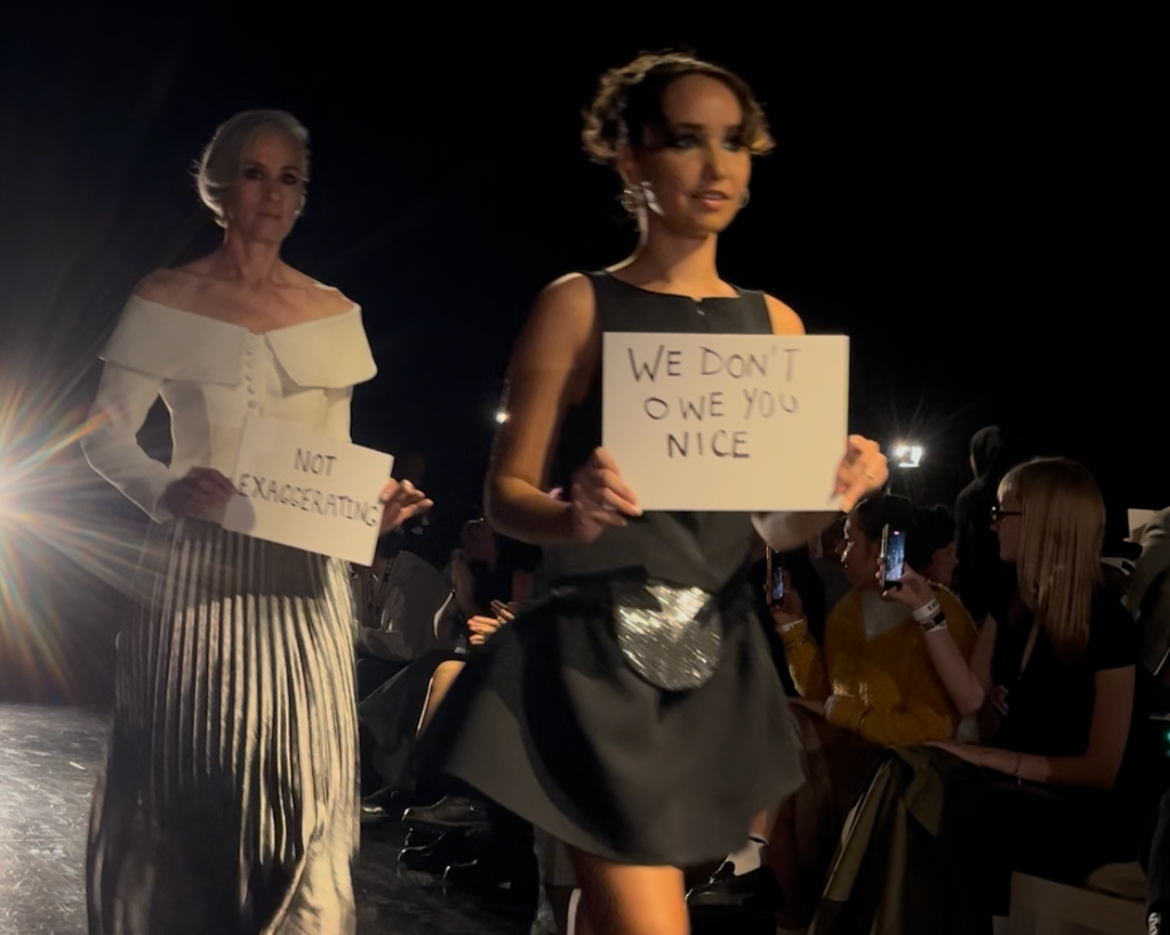
The final collection walk of the Unhidden runway
Protest built fashion weeks before
The week closed with Lynne Franks, whose reflections in conversation with Annabel Lindsay reminded everyone that even London Fashion Week itself once had to fight for legitimacy.
One of the best parallels London wasn't automatically taken seriously as a fashion capital when it launched. Media relationships had to be built. In its infancy, supermodels attended LFW as a favour on their way to ‘real fashion weeks’ - the platform had to become a platform.
Lynne also reminded us that International Women's Day began with seamstresses protesting exploitation.
Fashion has always been political. Creative translation of that is its absolute power.
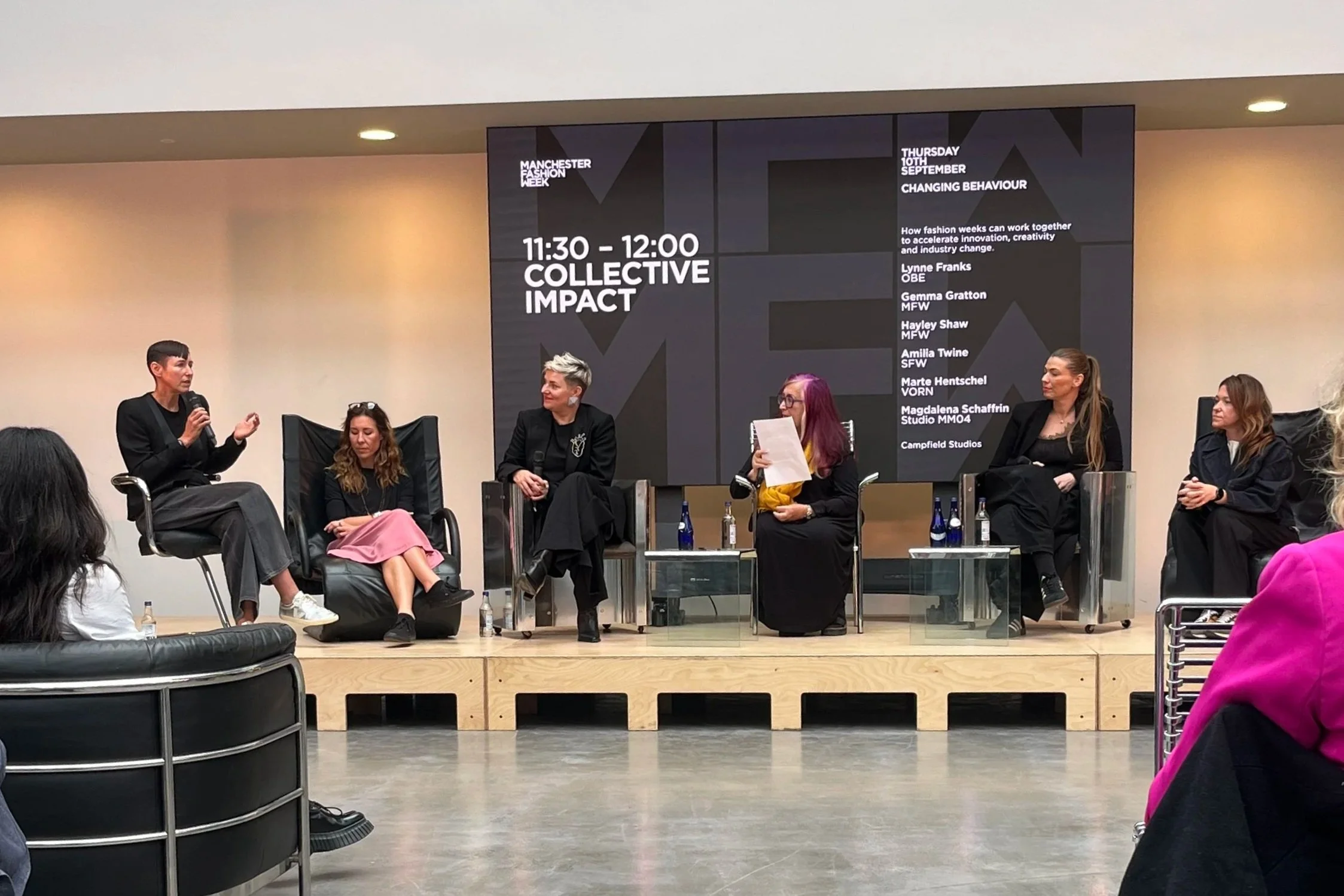
Fashion impact founders on the panel on Day 2
The biggest takeaway
Manchester Fashion Week could easily have tried to become another runway calendar.
Instead, it pushed something so much cooler. It anchored what Manchester is about - creativity, collaboration, unapologetic individuality, cultural consciousness.