

Iordanes Spyridon Gogos: the button, the alarm and beautiful inconvenience
At one point during the Iordanes Spyridon Gogos show, the fire alarm started sounding.
For a good while, nobody moved. Cameras stayed up. Eyes stayed forward and transfixed. It felt almost too perfect to interrupt the show, like an accidental embodiment of Alex Leach’s the world’s on fire but we’re still buying clothes. Except it was a real fire alarm, and everyone was evacuated.
The most telling part is that everyone came back.
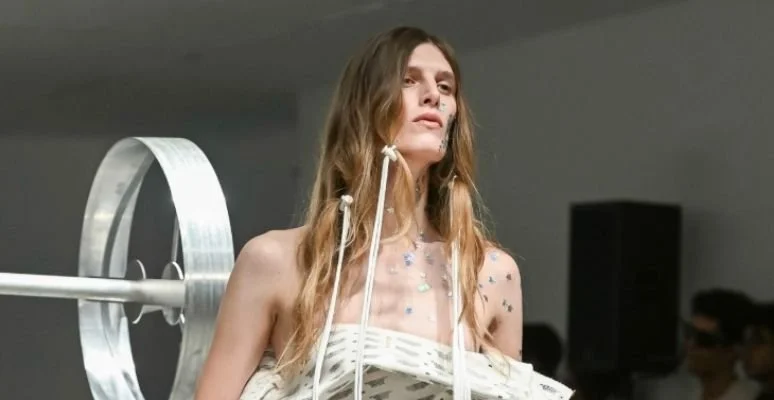
Photo Credit: AFW
Jordan Gogos’ work asks for a little more patience than fashion usually gives. It refuses the clean logic of trend, product and immediate wearability, instead building a world where garments sit somewhere between sculpture, textile research, performance, joke, devotion and community ritual. For AFW, the central question was deceptively simple: what is a buttonhole?
Through a pre-show monologue, Gogos treated the button as fashion’s tiny unconscious mechanism, something we use without thinking, but which can completely change the shape, category and meaning of a garment.
That idea moved through the collection in the most literal and chaotic way. Mismatched buttons and buttonholes reshaped tailoring, tops and dresses, forcing garments to behave incorrectly, becoming inevitably more interesting because of it.
The show also exposed how quickly fashion gets dismissed when it refuses to behave like product. One widely shared runway moment became the easy headline, flattening the collection into spectacle and stripping it from the wider context of Gogos’s practice - collaborative making, textile experimentation, existing materials and a deliberately disruptive approach to how new ideas enter the industry.
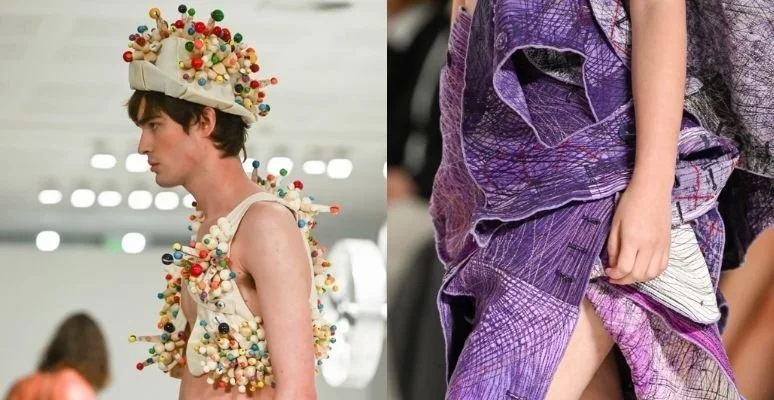
Photo Credit: AFW
With Iordanes Spyridon Gogos, the clothes are only one part of the system. The work sits across object, performance, community and material intervention. It is about using fashion as a ‘Trojan horse’ for stranger, more collective ways of making.
It is sustainability as disruption - using existing materials, collective making and textile experimentation to smuggle new ideas into the industry through what the brand calls a Trojan horse approach.
That collaborative spirit is probably the real spine of the brand. The cast included designers, artists and familiar creative figures, with collaborators moving through the runway as part of the work rather than standing outside it. Gogos has said the work cannot exist in a silo, and that feels true. This is fashion as community infrastructure: messy, excessive, relational, sometimes confusing, often beautiful because it has too many hands in it.
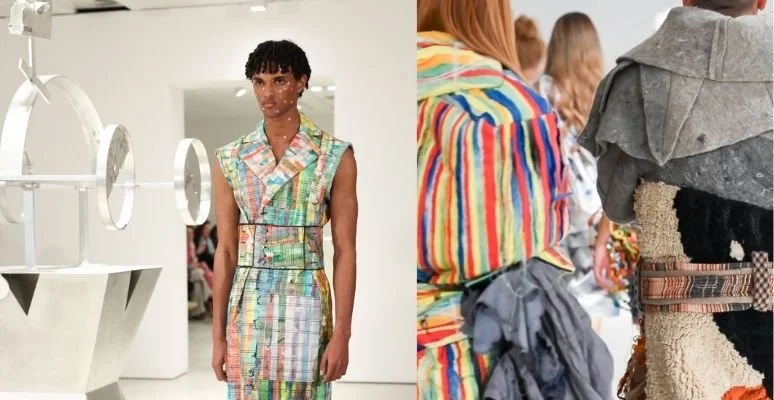
Photo Credit: AFW
The Skin Control collaboration felt like it was asking the same question as the clothes: what happens when the thing meant to fix, hide or fasten us is used ‘incorrectly?
It feels like a generational bind. Pimple patches have become flowers and stars - body markings across faces, hair and limbs are turned from concealment into decoration. A very literal reworking of shame into play.
Iordanes Spyridon Gogos makes fashion less comfortable to consume passively. You can love it, resist it, question it, roll your eyes at it, or come back after the fire alarm because you still want to see what happens next.
That might be the point.
In a fashion system trained to polish everything into clarity, Gogos keeps choosing the void, the wrong buttonhole, the unexpected attachment point. The garment doesn’t always resolve. The idea doesn’t always sit still. But the work keeps asking what fashion can become when it is allowed to be collaborative, unstable, overbuilt, emotionally loud and materially strange.
Not everything needs to be immediately legible to be doing something important.
Find more of our Australian Fashion Week breakdowns on sustainable fashion here.